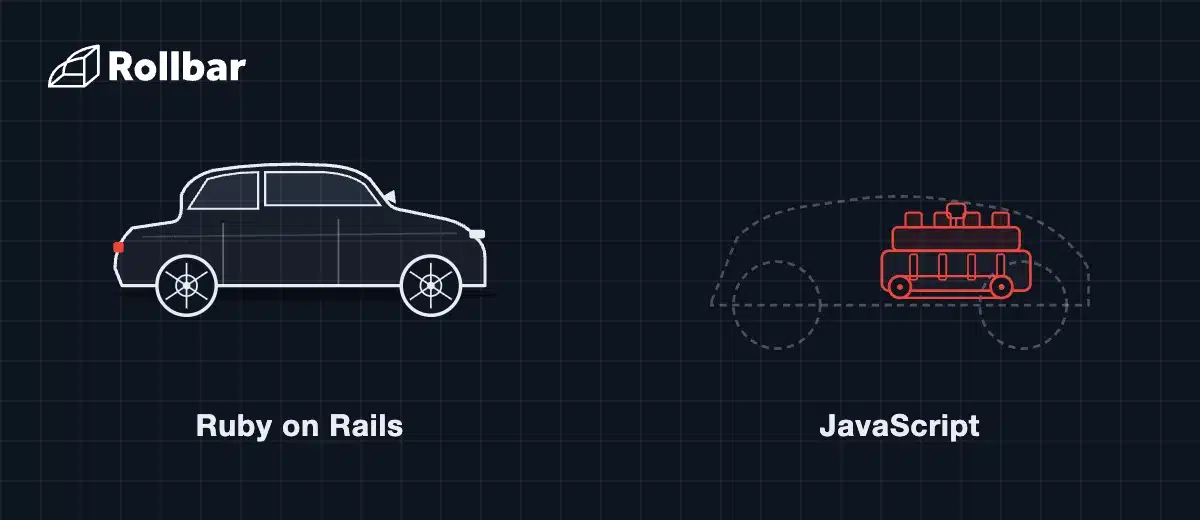
Ruby on Rails vs. JavaScript are not two competing brands, like Coke and Pepsi, or two airlines flying the same route. Rather, think of it like comparing a car to an engine. Rails is like the car: complete and ready to drive, with the seats, the dashboard, and the steering wheel already put together for you. JavaScript is like the engine: powerful, and the reason anything moves at all, but you still need to build a car around it.
For JavaScript, that car is almost always Node.js on the server, paired with something like Express or NestJS. So the comparison people actually want to make, whether they realize it or not, is Rails versus a Node.js stack.
Now that we're comparing two cars, let’s pop the hood. Rails wins when you want to ship a database-backed product fast, with strong conventions and fewer decisions along the way. A JavaScript stack built on Node.js wins when you need real-time features, heavy concurrency, or one language across your whole team. Here's what the performance benchmarks, the use cases, and the job market show, so your decision holds up when someone asks you to justify.
What each one actually gives you
Ruby on Rails is a framework for building web applications, written in Ruby. The “on Rails” part refers to creator David Heinemeier Hansson’s choice to build the framework around the ethos of "convention over configuration." In other words, Rails decides how to organize your files, talk to a database, and structure your app, so you're not starting from a blank page or making a dozen setup decisions before you write a line of business logic. Rails has a reputation for building things quickly. It helps that Ruby itself reads almost like plain English.
JavaScript, the scripting language that makes web pages interactive and later extended to the server with Node.js, doesn't hand you conventions the way Rails does. You choose your own framework, your own database library, your own project structure, which means more flexibility and also more decisions before you've built anything.
Both languages are dynamically typed by default, meaning type mistakes tend to surface at runtime instead of before you ship, but both now offer an optional fix: TypeScript for JavaScript, RBS or Sorbet for Ruby. Typing is unlikely to be a deciding factor between the two anymore.
The biggest difference between the two is Node.js' single-threaded event loop, which handles thousands of requests without blocking, giving JavaScript stacks an edge in real-time, high-concurrency work, something Rails wasn't built around.
Let’s take a closer look at the speed numbers.
Ruby on Rails vs. JavaScript performance benchmarks
Honestly, for most apps, your database and your network are the bottleneck, not your choice of Ruby on Rails versus JavaScript. But raw numbers still matter for high-concurrency work and CPU-heavy tasks, so here's what to expect.
In TechEmpower's Round 23 benchmarks, a widely used standardized test that exercises the database, the ORM, and server-side templating, Express on Node.js hit roughly 78,100 requests per second. Rails came in around 42,500. That's a huge 2x gap so choose Node.js if you're building something with massive concurrent traffic.
But Ruby's closing the distance fast. Ruby 3.4's YJIT compiler runs about 92% faster than the plain interpreter on the benchmarks the Ruby core team tracks. Ruby 4.0, released in December 2025, went further and introduced an experimental new compiler called ZJIT. It's not production-ready yet, and the Ruby team's own release notes say it's faster than the interpreter but not yet as fast as YJIT. The team originally aimed to close that gap by Ruby 4.1, but as of mid-2026 that milestone has slipped to "late 2026, timing TBD."
Why does Node.js pull ahead on raw throughput? Its event loop handles thousands of simultaneous connections without spinning up a thread for each one. That's perfect for chat apps, live dashboards, and anything streaming data continuously.
Rails can hold its own on CPU-heavy work though, since its multi-threaded Puma server doesn't hit the same single-thread ceiling Node.js does without extra help like worker threads or clustering.
The bottom line: Rails is fast enough for the vast majority of real-world apps, and it's getting faster every release. Don't pick your stack off a benchmark chart alone.
When to choose Rails, and when to choose a JavaScript stack
Reach for Ruby on Rails when you're building:
- Database-heavy CRUD apps, SaaS platforms, or marketplaces
- E-commerce sites and content management systems
- Admin dashboards and internal tools
- An MVP where speed to market matters more than raw scale
- Complex business logic that benefits from clean, readable domain models
Rails 8 sweetens the deal for smaller teams. It ships with Solid Queue, Solid Cache, and Solid Cable, so you can run background jobs, caching, and WebSockets without standing up Redis. Pair that with SQLite for your database and Kamal 2 for deployment, and you can run a real app off a single, inexpensive server.
Reach for a JavaScript or Node.js stack when you're building:
- Real-time apps: chat, live collaboration, multiplayer games, etc.
- Streaming platforms and anything with constant data flow
- High-concurrency APIs and microservices
- Serverless or edge-deployed applications
- A product where you want one language across your frontend and backend
And don't feel locked into an all-or-nothing choice. Plenty of teams run a Rails API underneath a React or Next.js frontend, or keep Rails at the core and spin up Node.js microservices for the parts that need real-time speed. You don't have to pick a side to get the best of both.
Ecosystem and community
JavaScript's ecosystem is enormous. npm, its package registry, hosts more than 4 million packages as of mid-2026, easily the largest in the industry. JavaScript has also topped the Stack Overflow Developer Survey's usage rankings for 13 years running, with 66% of the 49,000+ developers surveyed in 2025 using it.
Ruby's ecosystem through RubyGems is smaller at around 200,000 total gems, but it's mature and stable. You'll find well-trodden tooling for testing, background jobs, authentication, and payments, all built up over two decades of Rails' popularity. The community is tighter-knit.
What Rails and JavaScript look like at scale
Ruby on Rails powers some massive products. Shopify runs on Rails, and its 2025 Black Friday/Cyber Monday weekend peaked at more than 117 million requests per minute on its app servers. GitHub, Airbnb, and Basecamp all built and scaled on Rails, too, proof that "Rails can't handle scale" hasn't been true for a long time.
JavaScript and Node.js have their own scale story. LinkedIn's classic migration case cut its mobile-backend server count from 30 down to 3 after moving to Node.js, and saw performance run up to 20x faster in some scenarios. Netflix uses Node.js for parts of its UI layer, and Uber and PayPal both run Node.js in production at serious scale.
Worth noting: big companies rarely go all-in on one stack. Twitter famously outgrew Rails for parts of its infrastructure and moved core services to Scala. Netflix mixes Node.js with Java microservices depending on the job. Scaling stories are almost never "we chose X and never looked back."
What the job market for both looks like right now
We pulled live listings from Google Jobs for three searches: "ruby on rails developer," "node.js developer," and "javascript developer." Here's what that pull showed:
| Ruby on Rails | Node.js | JavaScript | |
|---|---|---|---|
| Listings pulled (maximum returned) | 46 | 164 | 136 |
| Full-time share | 85% | 67% | 73% |
| Salary listed | 30% | 20% | 29% |
| Reported annual range (USD) | $61K-240K | $30K-190K | $32.5K-221K |
The most reliable signal here isn't salary, it's volume. JavaScript and Node.js listings outnumbered Rails listings roughly 6 to 1 in this pull, which tracks closely with the broader popularity data: JavaScript's had the most users in the Stack Overflow survey for over a decade, while Ruby serves a smaller, more specialized market.
Rails listings also skewed more toward full-time roles (85%, versus 67-73% for the JavaScript-stack searches), while Node and JavaScript postings included a larger share of contract work. If you're weighing job security and role type as part of your decision, that's worth factoring in.
On pay, the picture is closer than the raw averages suggest. Our Rails sample's higher average leaned heavily on a handful of senior and principal-level postings, and with only 46 listings, that's an easy number to skew. The safer takeaway: both stacks offer real six-figure ceilings at the senior end, and neither one is a clear salary winner.
That lines up with what broader industry data shows, too. The U.S. Bureau of Labor Statistics puts the median software developer salary at $132,684 a year as of its most recent data, a number that doesn't split out by language since BLS tracks occupations, not tech stacks. Where language-specific data exists, Ruby has repeatedly ranked among the five highest-paying languages in past Stack Overflow surveys, even though it's used by far fewer developers than JavaScript. That's scarcity at work. Fewer people know Ruby well, so the ones who do can often command a premium, even as JavaScript wins hands-down on sheer job volume.
In short, both Rails and JavaScript jobs pay well at the senior level, and both have plenty of open roles.
So, which should you choose?
If you're building a database-driven product and want to move fast with fewer decisions, go with Ruby on Rails. If you need real-time features, heavy concurrency, or want one language across your whole stack, JavaScript and Node.js fit better.
But no matter which one you pick, something in production will eventually surprise you.
Catch what breaks, whichever stack you choose
That's where Rollbar comes in. Rollbar gives you real-time error monitoring that works the same way whether you're running Ruby on Rails, Node.js, or anything in between. You get smart, ML-based error grouping instead of a flood of duplicate alerts, stack traces down to the exact line, deploy tracking so you know exactly which release introduced a bug, and enough context about affected users that you're not guessing at severity.
And Rollbar just added something new: Rollbar Resolve, an AI debugging agent. When an error hits production, Resolve reviews your codebase with full context, figures out what actually broke, writes a fix, runs your tests in an isolated environment, and opens a pull request for you to review. You stay in control of what ships. Resolve just takes the repetitive bug-hunting off your plate.
Ready to spend less time guessing and more time shipping? Sign up for free today.