Opinions about the "best" React framework are like linting configs: everyone has one, and everyone thinks theirs is correct. So instead of adding to the noise, we did something slightly more useful - we scraped 127 React developer job postings from Google Jobs (the max available in the past month) and pulled out every framework and library mentioned in the descriptions.
No vibes. Just data.
Here's what the job market actually wants from React developers in 2026.
What is a React framework?
A React framework is a pre-built layer on top of React that solves common problems like page routing, data loading, and server rendering - so you don't have to wire all of that up yourself. The most in-demand React framework in 2026 is Next.js, which appeared in more job postings than all other React frameworks combined.
The Undisputed Core Stack
If you want to be hireable right now, three things show up in job posts so consistently they've basically become table stakes:
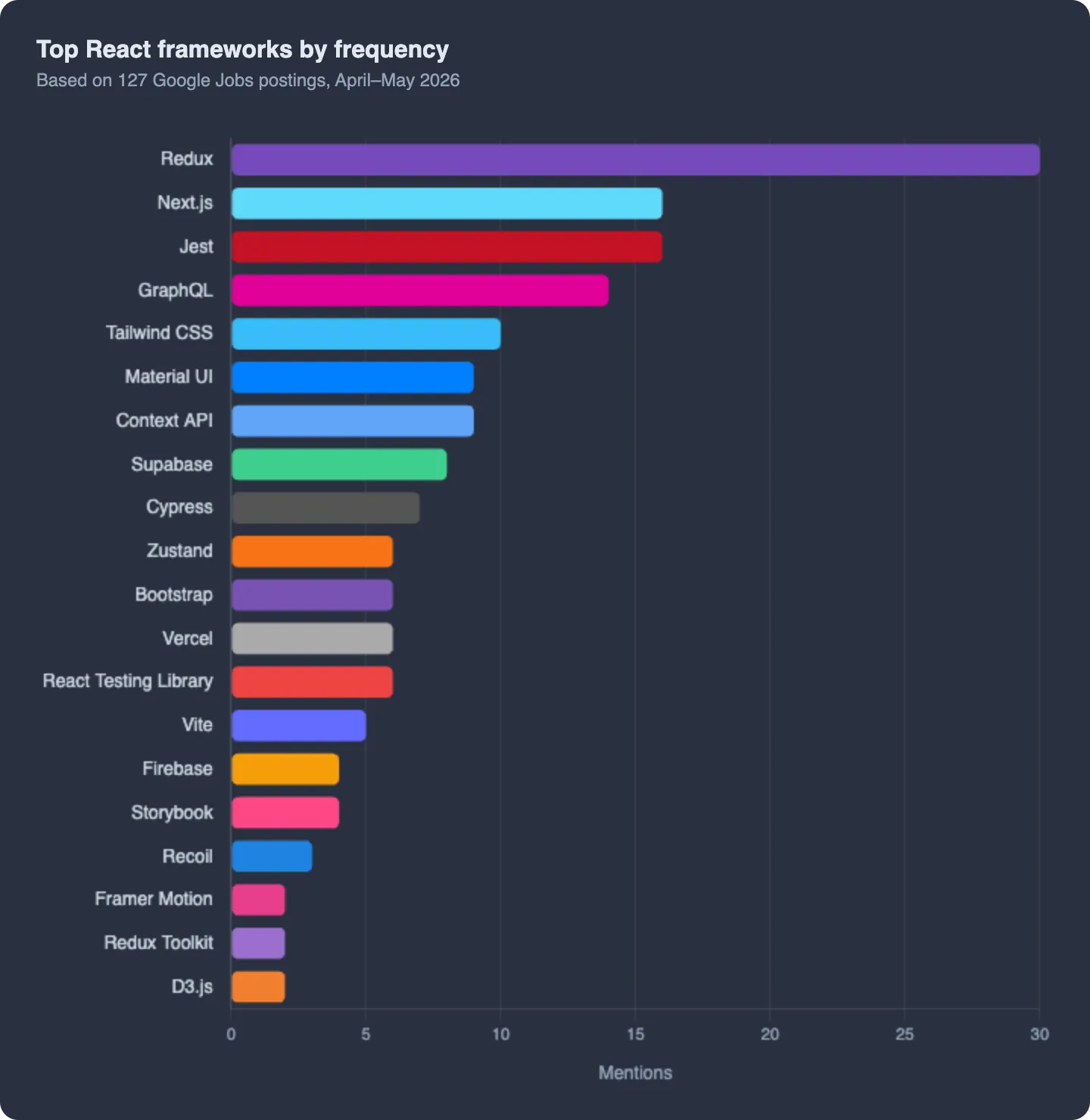
Next.js appeared in 16 of 127 job descriptions, making it the most popular React framework by a wide margin.
Among libraries - tools that solve one specific problem rather than providing full app structure - Redux came up in 30 postings, which will either reassure you or make you quietly weep depending on your feelings about boilerplate. Despite years of "Redux is dead" takes, it's still what a huge chunk of the industry reaches for. That said, lighter alternatives are gaining ground - more on that in a moment.
Vite appeared in 5 postings as the build tool of choice for teams that have moved on from Create React App (which appeared in exactly one job post, bless its heart).
These three, alongside React itself, form what you might call the "no-questions-asked" baseline for a lot of mid-to-senior roles.
Testing Is Non-Negotiable (For Serious Roles)
One pattern that emerged clearly: the more detailed and senior the job description, the more likely it was to list testing tools. Which makes sense - junior posts often just say "React" and call it a day; senior posts reveal what the team actually cares about.
- Jest — 16 postings
- Cypress — 7 postings
- React Testing Library — 6 postings
- Playwright — 2 postings
If you're trying to level up or target higher-quality companies, this is a strong signal about where to invest your time. Companies that list testing tools in their job descriptions tend to be the ones with actual test suites.
State Management: Redux Still Reigns, But It's Not Alone
Redux's 30 appearances might feel surprising given how much the community has moved toward lighter alternatives, but the alternatives are clearly making inroads:
- Context API — 9 postings (often mentioned alongside Redux for simpler state)
- Zustand — 6 postings
- Recoil — 3 postings
- MobX — 1 posting
The story here isn't that Redux is losing; it's that the state management conversation has genuinely opened up. If you're starting a new project today, Zustand has clearly crossed the threshold from "cool experiment" to "thing employers actually want."
Styling: Tailwind Is Winning
CSS-in-JS had a good run. The data says Tailwind is pulling ahead:
- Tailwind CSS — 10 postings
- Material UI — 9 postings
- Bootstrap — 6 postings
- Styled Components — 1 posting
- Emotion — 1 posting
Tailwind and Material UI are essentially neck and neck, which reflects a genuine split in the ecosystem: product teams building custom UIs lean Tailwind, while enterprise teams shipping internal tools often reach for a component library like MUI. Bootstrap's continued presence is a reminder that a lot of production software is quietly running on whatever worked in 2018.
The Backend-Adjacent Layer: GraphQL, Supabase, and Firebase
Several postings revealed a category of role that's less "React developer" and more "React developer who also touches the backend", and the tools of choice there were:
- GraphQL — 14 postings
- Supabase — 8 postings
- Firebase — 4 postings
GraphQL's strong showing reflects how many teams have settled on it as their API layer for complex data. Supabase sneaking into 8 postings is the underdog story here - a year or two ago it barely showed up in job posts. It's clearly become the default BaaS pick for teams that want Firebase-style convenience without the Firebase-style lock-in.
The Weird Stuff (That Pays Well)
A handful of libraries appeared in just one or two postings, but are worth calling out because they signal specific and growing niches:
- Framer Motion (2) and GSAP (1) — animation-heavy product work
- Three.js (1) and Konva.js (1) — 3D and canvas/CAD-style interfaces
- Recharts (1) and D3.js (2) — data visualization
- Shadcn/ui (1) and Radix (1) — the headless component + design system wave
These are small numbers, but if you're a React developer who also knows Three.js or has built a canvas editor, you're looking at a much shorter list of competitors for those roles.
The Curious Case of Remix: Zero Mentions
Here's the most interesting data point: Remix appeared zero times across all 127 job descriptions.
That's not entirely surprising once you know what happened to it. Remix v1 and v2 were React frameworks, but by 2024, the team had quietly folded most of what made Remix distinct - the loaders, actions, nested routing - directly into React Router v7. The creators themselves joked that Remix 2 had become "React Router, the Framework."
Then in May 2025, they announced Remix v3 and it no longer has anything to do with React. The team dropped a bombshell: Remix v3 completely abandoned React in favor of a Preact fork and an entirely new development philosophy. The framework now runs directly on the Fetch API using standard Request and Response objects, instead of Node's proprietary req and res system.
The reasoning makes sense: by 2024, the React ecosystem had grown complex, with developers having to manage Server Components, use server and use client boundaries, Suspense, and a flood of new hooks. The Remix team decided to stop chasing React's roadmap and instead design something simpler that would work the same way anywhere JavaScript runs.
Whether Remix v3 becomes a cult classic or a mainstream success remains to be seen. But for React developers right now, it's effectively a different product - which explains the radio silence in job posts.
What This Means for You
If you want to map this data to a learning priority list, it shakes out roughly like this:
- Next.js if you haven't already - it's the clear default for React frameworks
- Zustand as a modern Redux alternative worth knowing
- Tailwind CSS is clearly winning the styling wars
- Jest + React Testing Library if you want to be taken seriously at senior level
- GraphQL + Supabase if you're interested in full-stack roles
The framework ecosystem is less chaotic than it was a few years ago. There's a reasonably clear consensus stack emerging, and these job posts reflect it.
One More Thing: Don't Forget Error Tracking
You can pick the perfect stack and still ship bugs. That's just the job. What separates teams that catch issues before users do from teams that find out via a post on X is good observability tooling.
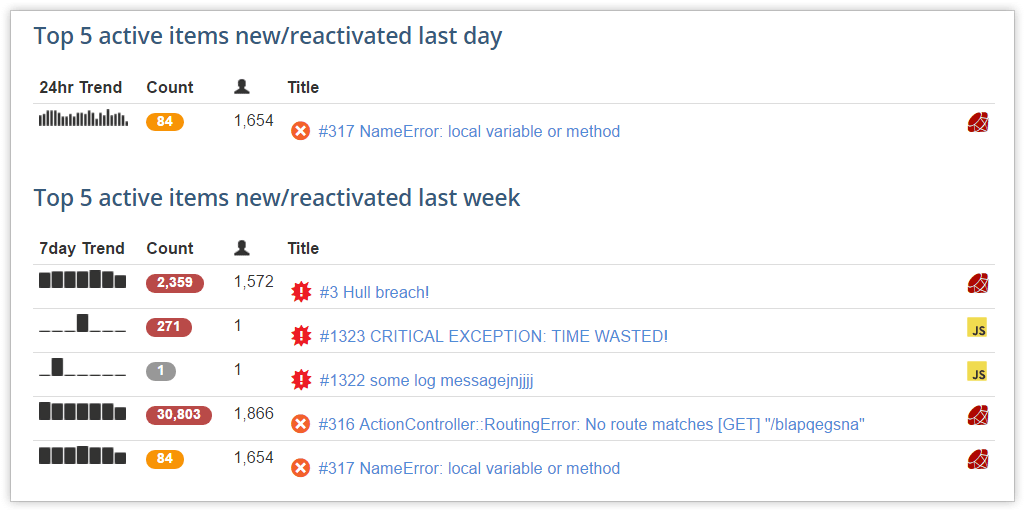
Rollbar has a first-class React SDK that integrates directly with your component tree. It catches unhandled errors, surfaces them with full stack traces, and helps you reproduce and fix them fast - whether you're running plain React or a Next.js app.
If you're starting a new project (or finally adding error tracking to an existing one), it's worth a look:
No framework choice will make your code bug-free. Good error tracking is the next best thing.