Search "best Python frontend framework" on Google and you'll get the same page over and over: a listicle ranking Streamlit, Gradio, Dash, NiceGUI, Reflex, and Flet, followed by a paragraph on each and a score out of ten that doesn't mean anything. None of them tell you which one to use for your project.
That's because a ranking doesn't fit this problem. These frameworks aren't better or worse versions of each other. They're built around fundamentally different execution models. Streamlit reruns your whole script top to bottom on every interaction. Dash wires up explicit callbacks. NiceGUI and Reflex hold state in memory and push updates to the browser over a WebSocket. Gradio wraps a single function. Flet renders Flutter. Asking which one is "best" is like asking whether a scalpel is better than a hammer.
So instead of another ranked list, this post gives you a decision tree. Answer two questions, and you'll get a framework recommendation along with the trade-offs you're accepting by choosing it.
Find your framework
Answer a question or two and get a straight recommendation, plus the trade-off you're accepting by picking it.
What's the main job for this UI?
How will this data app actually be used?
How far does it need to go?
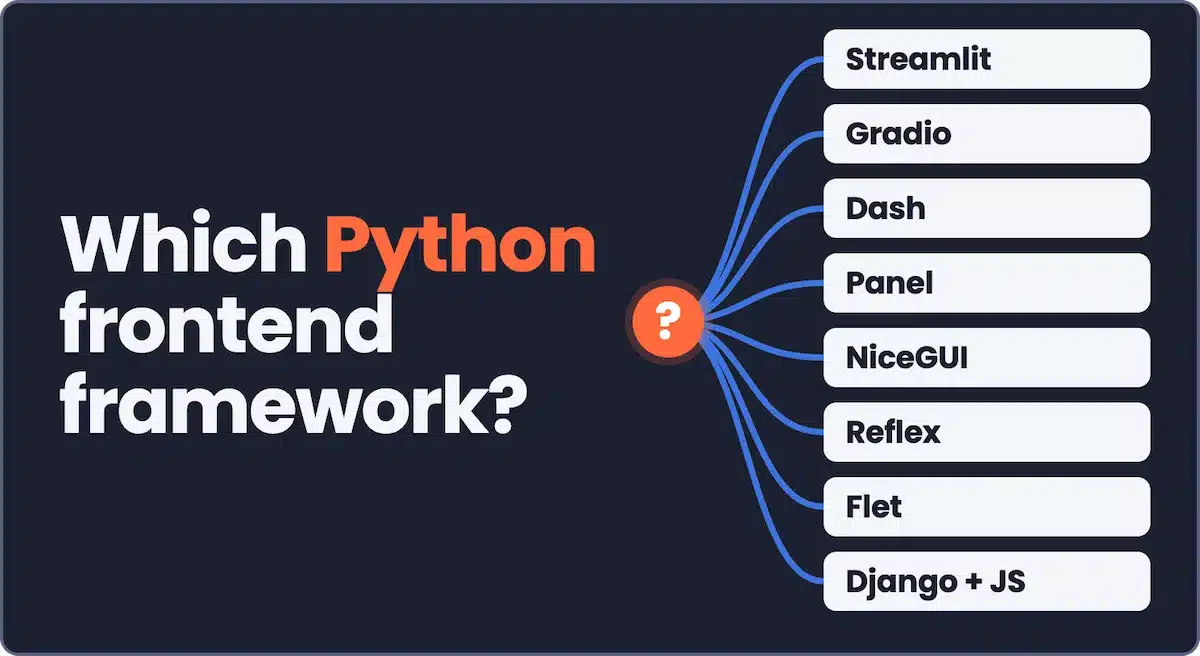
Eight possible answers can come out of that tree: Streamlit, Gradio, Dash, Panel, NiceGUI, Reflex, Flet, and - when pure Python turns out not to be the right tool for the job - Django or FastAPI paired with a JavaScript frontend. I've written out below the reasoning behind each one, so you can sanity-check your result or dig into the option you didn't pick.
Streamlit: for a data script you want to ship today
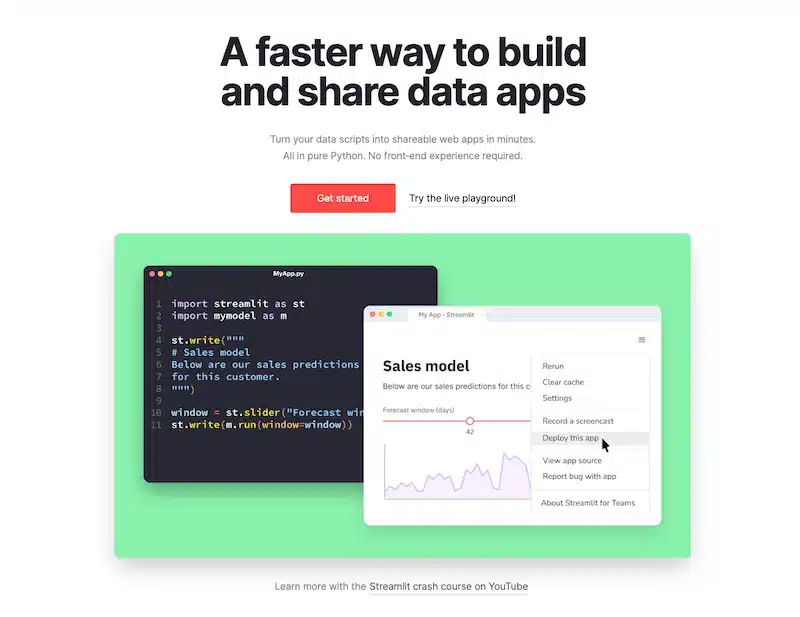
Streamlit is the right call when you have a working script (a pandas analysis, a model you want to poke at, a quick internal report) and you want it in front of other people with the least possible ceremony. It has the largest community in this space, a deep library of built-in data widgets, and free hosting.
The trade-off is Streamlit's execution model: by default, any interaction reruns the entire script from the top. Streamlit has narrowed that gap with fragments that let part of a script rerun on its own and native support for async code in app scripts, but state, caching, and layout still take deliberate structuring once an app grows past a page or two. It's also easy to end up with an app that looks like every other Streamlit app, since customization takes real effort to push past the defaults.
Gradio: for a model or chat demo you want to share
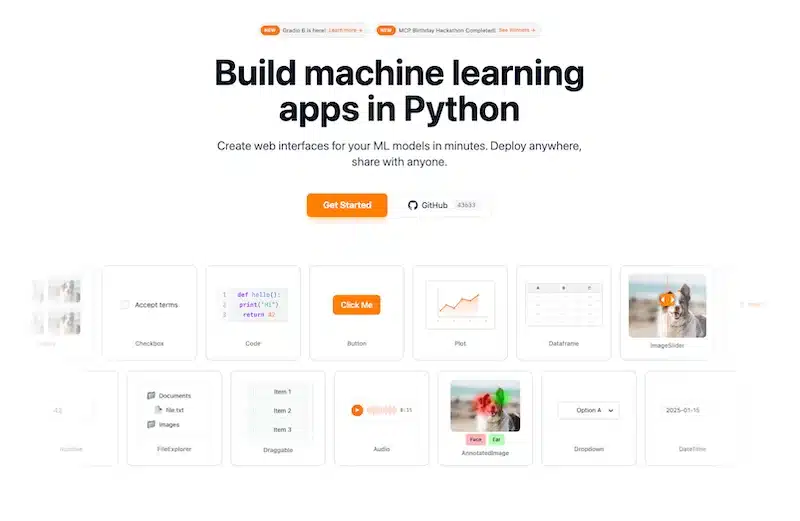
Gradio is purpose-built for wrapping a Python function (usually a model) in an input-and-output interface in a handful of lines. gr.Interface gets you a demo instantly, Blocks gives you a composed layout when you need one, and ChatInterface covers conversational apps out of the box. Sharing is baked in through Hugging Face Spaces.
Gradio 6 rebuilt the frontend on Svelte 5, and the migration guide says the result is significantly more performant, lighter, and easier to customize than previous versions of Gradio. The chatbot component also now renders HTML and markdown tags by default, a direct response to how often LLMs return formatted output. The trade-off is scope: once your app needs pages, persistence, and product logic that goes beyond model input and output, you're fighting the framework's grain.
Dash: for production-grade analytics apps
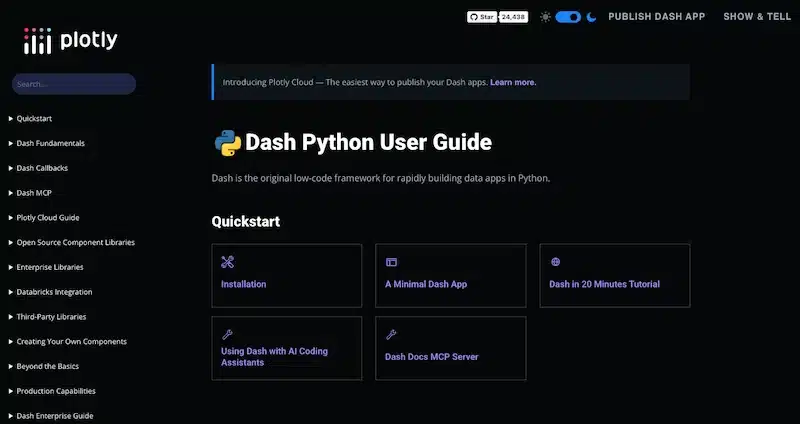
Dash is built around Plotly-quality charts and a callback model that's more explicit and predictable at scale than a rerun-everything script. It's the choice when the app is genuinely analytical (think cross-filtered dashboards, linked charts, BI tools, etc.) and needs to survive contact with more than a handful of users.
Dash 3 made React 18 the default rendering layer and added typed components. More recently, Dash apps can run on a FastAPI or Quart backend instead of only Flask, which matters if the rest of your stack has already standardized on one of those. The trade-off is verbosity: callback wiring adds up fast in a large app, and Dash's own docs are explicit that you have to be careful not to treat shared, process-level state as if it belonged to one user.
Panel: for notebook-native exploration at data scale
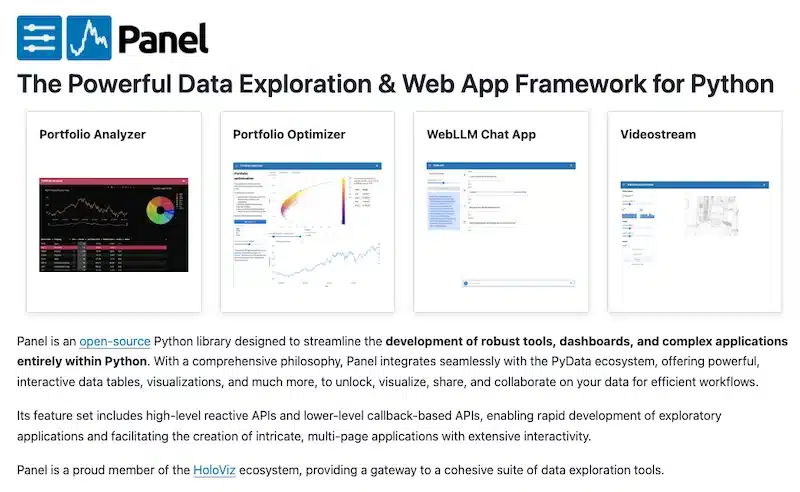
Panel is the pick when your team already lives in the PyData stack (hvPlot, HoloViews, Datashader) and needs dashboards that work from a Jupyter notebook all the way to a deployed app, including datasets too large for a browser to render directly. It also runs entirely client-side via WebAssembly when you need zero server ops.
The HoloViz team recently shipped panel-material-ui for a more polished default look, along with Lumen AI 1.0, a conversational layer for exploring data built on top of Panel. The trade-off is a smaller community than the others here and a steeper learning curve.
NiceGUI: for internal tools with real, explicit state
NiceGUI is the simplest, most direct option on this list: no rerun magic, no compiled build step, just an event-driven Python UI with state you manage yourself. It's built on FastAPI, pushes live updates over a WebSocket, and ships with useful components i.e. tables, AG Grid, 3D scenes. It also has a native-window desktop mode, and its maker, the German robotics company Zauberzeug, runs it in production for real hardware and lab tooling, which shows in how well it handles real-time use cases.
NiceGUI 3.0 introduced a leaner "script mode" that drops the auto-generated index page every route used to get, plus an event system for talking to long-lived backend objects. The trade-off is that you own the UI lifecycle yourself, which is more code up front than Streamlit for a simple data app, and the community is smaller than Streamlit's or Reflex's.
Reflex: for a full-stack app without writing JavaScript
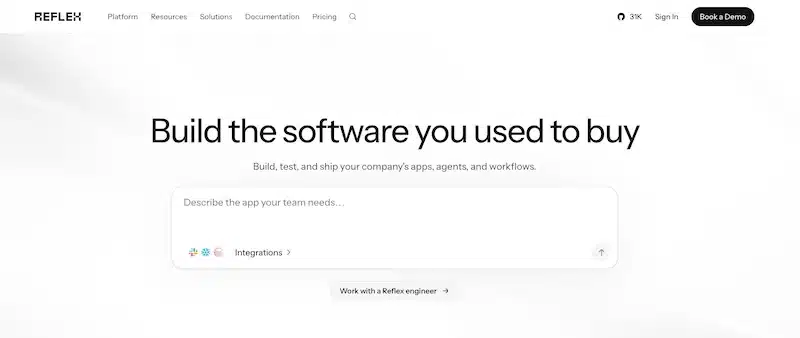
Reflex is the only option here that's a genuine full-stack web framework rather than a dashboard tool. You write Python state classes and event handlers, and Reflex compiles a real frontend and a FastAPI backend from that. You get multi-page routing, an explicit state and event model instead of script reruns, the ability to wrap arbitrary React components, and a one-command deploy.
Reflex recently swapped out its underlying frontend build tooling, moving off Next.js onto a lighter React Router and Vite-based setup - a change that trims build times and dependency weight without changing how you actually write Reflex code. The trade-off: there's a Node toolchain running under the hood even though you never touch it directly, more moving parts to deploy than a single Streamlit script, and the framework is still pre-1.0, so breaking changes do show up between releases.
Flet: for one codebase across desktop, mobile, and web
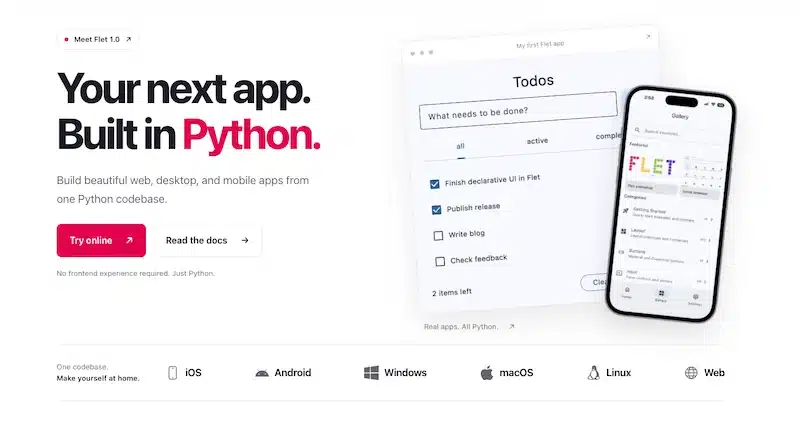
Flet renders Flutter, which means the same Python codebase packages as a real installable desktop app, a real iOS or Android app, and a web app. If you need something a user actually installs rather than opens in a browser tab, nothing else here gets you there.
Flet 1.0 went stable in September 2026, the product of what the team calls four years in the making and a ground-up rewrite. The trade-off is that you're working in Flutter's widget model rather than web idioms, and the web build target runs through a Python-in-the-browser runtime, so expect a heavier initial load than any of the browser-native options on this list.
When pure Python isn't the right tool: Django, FastAPI, and a JS frontend
If your job doesn't fit any of the seven options above (e.g. you need server-rendered pages at Django's scale, a FastAPI backend behind a dedicated React app, or pixel-perfect, SEO-heavy marketing pages), that’s not the tree failing you. It means all seven pure-Python options are just not for this particular job.
A full JS frontend is actually the common way this plays out. Most teams who land in this bucket go back to plain, server-rendered templates, sometimes with a little JavaScript sprinkled in for interactivity, rather than a full single-page app. Django is a useful bellwether here because its own developer survey tracks that exact shift: drawing on roughly 4,600 responses, it found that HTMX has grown from 5% in 2021 to 24% of respondents, with Alpine.js seeing similar growth, while React's share among Django developers has fallen over the same period. If your team already knows Django or Flask and your UI is mostly forms, tables, and navigation, templates plus a sprinkle of HTMX is a completely reasonable answer. It's just not a "Python frontend framework" in the sense most people searching that phrase actually mean.
When the tree doesn't give you a clean answer
Decision trees simplify. Real projects don't always cooperate, so here are a few cases where the answer above deserves a second look.
Your Streamlit prototype became the tool fifty people use every day. This is the single most common story. Before rebuilding anything, try Streamlit's own answers to the problem: fragments and async support both exist specifically to chip away at the "reruns everything" complaint. Migrate to NiceGUI for an internal tool, or Reflex for something customer-facing, only once the actual pain is state and layout rather than performance.
Your Gradio demo needs to become part of the real product. Gradio can be mounted inside a larger web app instead of standing alone, so the model-facing piece doesn't have to be thrown away. Build the surrounding product (accounts, navigation, persistence) in Reflex or a conventional web framework, and let Gradio keep doing what it's good at.
You already run a FastAPI or Flask backend. Dash can now sit directly on a FastAPI server, and NiceGUI is built on FastAPI from the ground up, so neither one forces you to stand up a second service just for the UI.
It has to run with no backend server at all. Panel's WASM export, Shiny for Python's Shinylive, and Flet's web build all lean on Python-in-the-browser runtimes for exactly this case - offline demos, static hosting, zero ops. Expect a heavier first load in exchange for that.
You need both a desktop app and a web app from one codebase. Flet covers this cleanly, mobile included. If mobile isn't actually a requirement, NiceGUI's native-window mode covers desktop-plus-browser without pulling in Flutter's widget model at all.
Don't forget error tracking
None of these seven frameworks stops you from shipping bugs. Your choice of framework mostly just changes where the bug hides. A rerun in Streamlit, a callback in Dash, an event handler in NiceGUI or Reflex. An unhandled exception inside any of these cycles can fail silently unless something is watching for it.
That's what Rollbar is for. It's a code-first error monitoring platform with a Python SDK covers what's actually running underneath every framework in this post. It groups similar errors automatically, shows you the stack trace and deploy that introduced a bug, and pairs errors with session replay so you can see what the user was doing when things broke.
If you'd rather skip straight to the fix, Rollbar's new Resolve agent will review your codebase, figure out what's causing a given error, and open a tested pull request with the fix. You just approve it.
Rollbar has a generous free tier (5,000 error occurrences and 1,000 session replays a month, no credit card required) plus a 14-day full-access trial on paid plans.
Start monitoring your Python app with Rollbar →