The software industry has decided, fairly recently and more or less all at once, that the right way to write code with AI agents is to build a factory. It's a good metaphor. Factories are where things get made in a predictable order by specialized stations, and that is roughly what you want from a pile of coding agents. It's also a slightly funny metaphor, because every company selling a software factory draws the factory's walls in a different place, and the walls tend to sit exactly where that company's product ends.
Warp launched its version, Warp Factories, in August 2026. You've probably looked at it and are now wondering what else is out there. Below are five alternatives.
What Warp Factories is, and why people keep shopping
In Warp Factories, you define the factory as files in your repo: a factory.yaml plus agent definitions, checked in and reviewed like any other config. Each stage gets its own model and its own coding agent, such as Claude Code or Codex. A coordinating agent, which Warp calls the foreman, moves work through the stages. The default stages are triage, spec, implementation and code review. It's a well-designed system, and if you like the idea of your whole engineering process being a pull request away from changing, you will like it a lot.
People who look at it and then keep looking usually mention some combination of these:
- Access. Warp moved Factories into early access at the end of August. The pay-as-you-go tier on its pricing page still routes you through a request-access form. At launch, Warp said it was "onboarding a limited number of companies." That's a normal thing for a new product to say, and it also means you may not be one of them.
- Customers. Warp hasn't named a Factories customer. Its best evidence is its own: Warp ran its internal factory and cut its cost per pull request from $80 to $30. That's impressive, but it was produced by the people who built the factory, on the code of the people who built the factory, which are about the friendliest test conditions available. The Factories page carries only one customer quote, from a VP of engineering at an unnamed Series C infrastructure company.
- Data. Warp's servers coordinate every run. Even when you host the workers yourself, Warp's docs say prompts, results, transcripts and telemetry still pass through Warp, and those can contain your code. The Enterprise tier on the pricing page lists self-hosted transcripts and conversation data, so the real answer may depend on your contract. Ask Warp.
- Where it stops. The default factory ends at code review. Warp's launch post describes a monitoring agent that could watch Sentry and file Linear tickets, but that's a stage you build, not one you get.
- Setup. Warp describes Factories as infrastructure, which means your team writes the skills, context and agent definitions. Whether that's a feature or a chore depends on how you feel about writing YAML.
Their pricing is now public:
| Tier | Price | Usage |
| Pay as you go | $0/month | API rates plus 20% |
| Build | $20/month | API rates |
| Business | $50/user/month | Billed separately |
| Enterprise | Custom | Billed separately |
Factory usage is billed separately on every tier. Teams that qualify for early access can get up to $10,000 in usage credit.
How we compared Warp alternatives
We asked four questions of each factory:
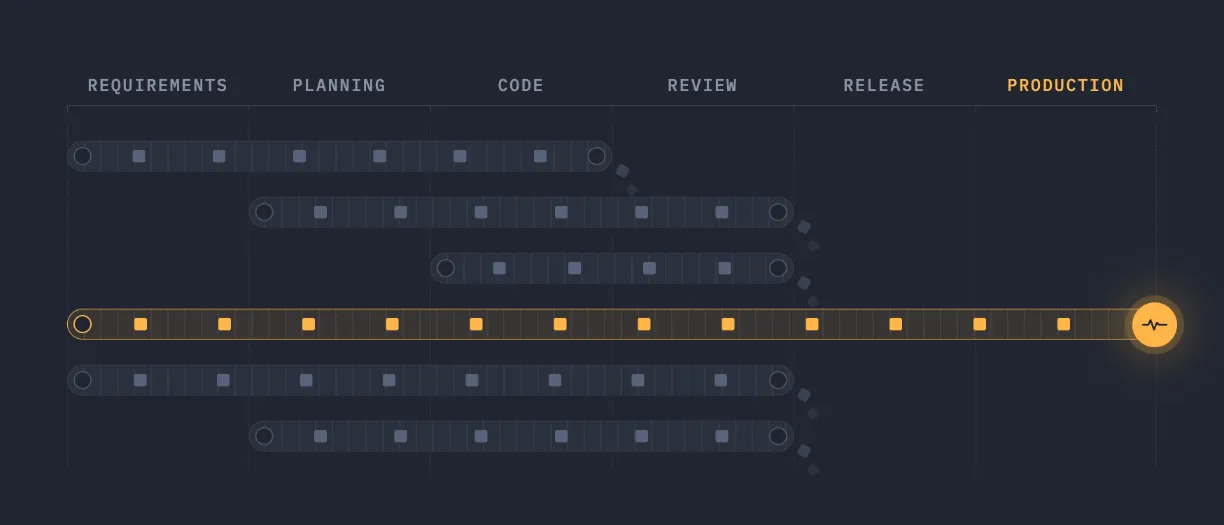
- Where does its work start and stop along requirements → ticket → PR → review → release → production?
- Who picks the coding agent, you or the vendor?
- Where does it run?
- How do you get in, and what does it cost?
The first question is where the tools really differ. Code review tells you whether a change looks right. Production tells you whether it was right. Every tool below stops somewhere between those two points, and where it stops determines how much of the work is still yours.
Warp Factories vs. the alternatives, side by side
Where each factory starts and stops
| Tool | Requirements | Planning | Code | Review | Release | Production check |
| Warp Factories | — | ✓ | ✓ | ✓ | — | — |
| Rollbar Lines | ✓ | ✓ | ✓ | ✓ | ✓ | ✓ |
| 8090 | ✓ | ✓ | ✓ | — | — | — |
| Opsera Forge | ✓ | ✓ | ✓ | ✓ | — | — |
| Tembo | — | — | ✓ | ✓ | — | — |
| Factory | — | ✓ | ✓ | ✓ | — | — |
— means the vendor's public materials don't describe it.
Setup, hosting, access and price
| Tool | Who sets it up | Where it runs | Access | Starting price |
| Warp Factories | You | Warp's cloud; your own workers on Enterprise, with Warp still coordinating | Early access | $0 + usage |
| Rollbar Lines | You, or Rollbar engineers | Rollbar's cloud (self-serve, planned) or your systems (white glove) | Demo | Not public |
| 8090 | 8090's engineers | 8090's cloud or your environment | Demo | Not public |
| Opsera Forge | Opsera scopes the first project with you | Opsera's cloud, your systems, or a mix | Demo | Not public |
| Tembo | You | Tembo's cloud; your systems on Enterprise | Self-serve | Free |
| Factory | You, with Factory engineers for enterprise customers | Factory's cloud; your systems on Enterprise | Self-serve | $20/month |
1. Rollbar Lines
We built this one, which makes us the least objective people to describe it. We’ll try anyway.
Rollbar Lines takes the factory metaphor more literally than most, which is where the name comes from. A line is an assembly line for software. A request goes in at one end, moves through a fixed series of steps, and comes out the other end as shipped code. Each step is a station with an agent assigned to it, and your team configures which agent works each station. The line is the product, and any single coding agent is one part it can use. That's the same basic idea as Warp's per-stage agents, and we're not going to pretend otherwise.
Rollbar's reference line works like this:
- An agent interviews the team and writes requirements, which a person approves.
- The same agent turns the approved requirements into a project and breaks it into tickets.
- A project manager agent moves tickets forward.
- A coding agent writes the pull request.
- A review step checks every PR before a person merges it.
Each requirement links to its tickets, and each ticket links to its PR. When someone asks why a piece of code exists, you can point at the requirement that asked for it, which is more than most codebases can say about most of their code.
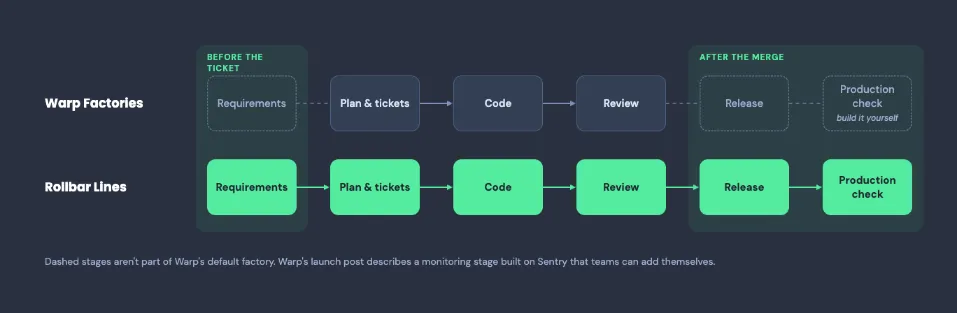
The real differences from Warp are at the two ends of the line.
At the front, the line starts before there's a ticket, with requirements a person has signed off on.
At the back, the line keeps going after the merge. Once a change ships, the line checks production to see whether the change did what it was supposed to. Warp’s default factory has no production stage, and its monitoring stage runs on Sentry. Rollbar started as an error monitoring company, so a Rollbar line runs that check on Rollbar.
- Self-serve: you build your own line and run it in Rollbar's cloud.
- White glove: a Rollbar team builds the line with you on your own systems.
A line will be able to move from one to the other without a rewrite.
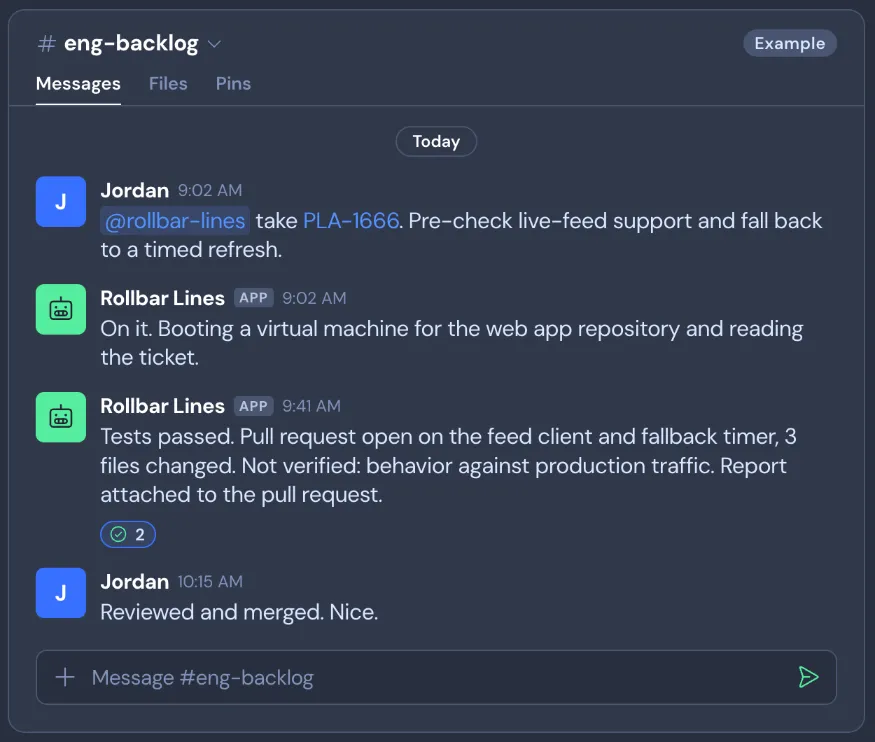
One honest limitation: self-serve isn't live yet, so for now the only way in is a demo with a Rollbar engineer.
2. 8090
8090 calls its product Software Factory. Of the tools here, it's the closest to Rollbar Lines on where it starts, which is business requirements. Its hosted app turns plain-English requirements into Blueprints, the technical designs engineers review, and then into Work Orders. The Work Orders go to your engineers' own agents through MCP, in Cursor, VS Code or Claude Code.
That handoff is where 8090's part of the factory ends; your agent writes the code. 8090 has added cloud agents that keep running after you close your laptop, so the far end of the handoff isn't limited to someone's laptop anymore. 8090 also has a module for collecting and triaging feedback. Its pages don't describe taking production error data in or checking what a change did after release.
Its best proof is legacy modernization. 8090 says it extracted more than 100,000 business rules from more than 18 million lines of COBOL in Medicare's claims systems, for the Centers for Medicare & Medicaid Services. It wrote each rule up as a plain-English spec traced to the lines of code it came from, and the teams building Medicare's replacement claims systems use those specs to test their work. EY appears on 8090's customer list and is quoted on its site. Other named customers include BISSELL, IFS, AdaptHealth and Dompé.
8090 doesn't publish prices. Its FAQ says pricing is either scoped with you or billed by the month, and the way in is a conversation with its team. An earlier version of its pricing page listed $200 per user per month plus tokens, with free view-only seats; that page now redirects to the homepage.
8090 announced a $135M Series A led by Salesforce Ventures in June 2026.
3. Opsera Forge
Opsera launched Forge in April. On October 28, 2026, three days before this post, Opsera relaunched the whole company as an AI-native software factory with Forge at the center. That tells you something about how fast this category moves, or about how well the word "factory" tests with buyers, or both.
Forge turns intent into versioned "Living Specs," then into Work Orders that carry requirements, tests, architecture and the definition of done. Underneath sits a knowledge graph of your codebase, business rules, dependencies and policies.
Forge doesn't write the code. Opsera lists Claude Code, Copilot, Windsurf, Codex, Devin and Grok Build as the assistants that do. Forge's job is governance:
- It checks policy and security before code gets generated.
- A person approves every merge.
- Each change carries a record linking the requirement, the tests that cover it and the approver.
If your auditors have opinions, this is the tool built with them in mind.
It runs self-hosted, hybrid or as managed SaaS. There's no public price. The calls to action are a demo or a modernization assessment, and Opsera offers a free codebase analysis it calls ForgeScore.
Read the customer logos carefully. Opsera's About page names Honeywell, Cisco, Sephora, Workday, Conduent and Belcorp as Opsera customers. But the Cisco case study on Opsera's homepage covers Opsera's analytics product used with GitHub Copilot, not Forge. The case studies on the Forge site itself are Senao Wireless and Belcorp.
Forge's pipeline ends at "Evidence," which links each release back to its specs. Nothing on its pages describes taking production signal in after release.
4. Tembo
Tembo runs other companies' coding agents, among them Claude Code, Codex and Cursor, each session on its own Linux VM. Work comes in from Slack, Linear, GitHub, Jira, Sentry and Datadog, and a run ends in a pull request. Tembo also reviews pull requests: when one opens, its agent runs the tests, builds and launches the app, and posts comments, though a person still approves the merge. In terms of our comparison, Tembo covers the stretch from ticket through review, and covers it well.
Tembo has a prebuilt template that opens fix PRs for Sentry errors, triggered when Sentry creates or regresses an issue. Tembo's materials don't describe checking whether a merged fix worked. If it didn't, Sentry will presumably regress the issue and Tembo will open another PR, which is a feedback loop of a kind.
Tembo's published proof is Tilt, a consumer fintech that runs Tembo self-hosted on Azure. Between March 2 and August 19, Tilt had:
- 110 engineers working across 282 repositories
- 1,200 agent-written PRs, 790 of them merged
- A monthly merge rate that rose from 64% in April to 81% in July
That's the most specific public customer data in this post. Other vendors could stand to publish more numbers like it.
Tembo’s pricing:
| Plan | Price | Usage allowance | Users |
| Free | $0 | $10, one time | 1 |
| Pro | $60/month | $60/month | Up to 5 |
| Max | $200/month | $200/month | Up to 10 |
| Enterprise | Custom | — | — |
The allowance pays for VM time, billed by the minute, and any model usage through Tembo. If you bring your own model keys, inference through Tembo is free but VM time still counts. Tembo raised about $20 million back when it sold hosted Postgres, and has since rebuilt itself around coding agents.
5. Factory
Factory is a company named Factory that sells a software factory, which makes this section tricky to write. It sells its own coding agents, called Droids, across a desktop app, CLI, SDK, web, Slack, Linear, Jira and GitHub. You can choose the model behind a Droid, including your own API keys, and define custom Droids in Markdown, even importing subagents you built in Claude Code. The agent itself is always a Droid, though; you can't hand a stage to Claude Code or Codex the way you can in Warp or Tembo. Its Missions feature has a Droid plan features and milestones with you before writing code, then run QA tests against each feature.
Factory's code review bot can approve a pull request on its own. Factory's docs say it "submits an approval when no issues are found." This is efficient. It also means the quality inspector and the production line can be the same company's robots, which some teams will love and others will want to think about for a minute. Factory's dashboards report cycle time, autonomy ratio and cost per merged PR. We didn't find a Factory page that describes checking production after a merge.
The customer list is long. Coverage of the funding names NVIDIA, Blackstone, Palo Alto Networks, Adobe, RBC and T-Mobile. Factory's pricing page adds Adyen, HP, DoorDash, Under Armour and others, and quotes the CTO of Tilt. Tilt is also Tembo's case study, so Tilt apparently believes in diversification.
Pricing for individuals:
- Pro: $20/month
- Plus: $100/month, with about five times Pro's usage and Factory-managed computers for the Droids
- Max: $200/month, with about ten times Pro's usage
For organizations, Teams costs $60/month plus $40 per seat for up to 10 seats. Business and Enterprise are priced by quote, and Enterprise adds dedicated compute, on-premise deployment and data residency.
Factory raised $200M at a $5B valuation in September, five months after raising $150M at $1.5B. That's a valuation that more than tripled in less time than it takes most companies to finish a migration.
Questions to ask in any demo
Whichever of these factories you look at, the demo will go well, because that's what demos are for. These questions get past it to the differences that matter.
- Where does your product's work stop, and what would we have to build ourselves? Each tool here covers a different stretch of the pipeline, and whatever falls outside that stretch is still your team's job.
- Who sets it up, and who keeps it working when our code or the models change? Some vendors send engineers to build it with you. Others send documentation.
- Where do our code, prompts and transcripts go? Hosting the workers yourself doesn't always settle it. Warp's docs, for example, say transcripts still pass through Warp's servers.
- After a change merges, how do we find out whether it worked? For most of the tools above, the honest answer is the same way you find out today.
- What results can you show from a named customer, on code you didn't write? A vendor's results on its own code are a fair start, but they were also produced under the friendliest test conditions available.
See a line on your own systems
Set up a demo, or talk with a Rollbar engineer about where Rollbar Lines would fit.